

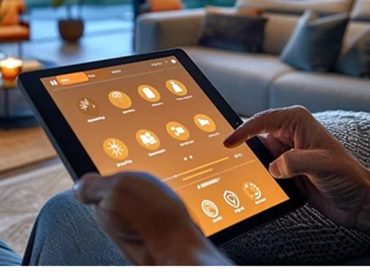


Voice assistants like Amazon Echo, Google Nest, and Apple HomePod have become part of everyday life. They allow you to:
They’re easy to use and perfect for anyone who wants a more connected home.
Smart bulbs let you adjust brightness and color directly from your phone. They help create the right atmosphere at any moment and reduce energy consumption thanks to automated scheduling.
Wi-Fi cameras, smart doorbells, and motion sensors make it easy to monitor your home even when you’re away. Real‑time notifications and cloud recordings offer a level of security that was once unthinkable for private homes.
Smart thermostats learn your habits and automatically adjust the temperature. The result is a consistently comfortable environment and optimized energy use, with real savings on your utility bills.
Robot vacuums and mop‑cleaners are among the most appreciated smart devices. With room mapping and app control, they keep your home clean even when you’re busy or out for the day.
Modern Smart TVs and streaming devices turn your living room into a complete multimedia hub. Movies, series, music, games, and video calls are all accessible in seconds, without complications.
Technology also supports personal well‑being at home. Some of the most useful devices include:
These tools help improve air quality, sleep, and daily routines.
The kitchen is one of the spaces most transformed by technology. Today you can find:
All designed to make meal preparation faster and more enjoyable.
Technology is no longer just an accessory — it’s a practical way to improve life at home. Whether it’s comfort, security, or organization, smart products are a real investment that simplifies daily routines and makes living spaces more pleasant.
The story of the Web starts with Tim Berners‑Lee, a researcher at CERN. His goal was simple: create a system that allowed scientists to share information quickly and efficiently.
This led to the creation of three fundamental components:
In 1991, the first website became publicly accessible. A revolution had begun.
The Web truly took off with the arrival of Mosaic, the first graphical browser. For the first time, users could view images and text together.
Soon after came Netscape Navigator, which dominated the mid‑90s. Microsoft responded with Internet Explorer, sparking the famous “browser war.”
During this period, the Web became:
With the rise of Web 2.0, the Internet changed dramatically. It was no longer just a place to read — it became a place to participate.
This era saw the birth of platforms we use every day:
Pages became dynamic, interactive, and constantly updated. It was the beginning of social networks and modern digital communication.
The arrival of the iPhone and Android smartphones brought the Web into our pockets.
From that moment on:
The Web became faster, more personalized, and increasingly visual.
Today’s Web is a complex ecosystem powered by:
Technologies like WebAssembly, 5G, and progressive web apps (PWAs) are opening new possibilities, making the Web more powerful than ever.
In just a few decades, the Web has evolved from a scientific project into a global network connecting billions of people. Its evolution continues every day, driven by innovations that reshape how we communicate, work, and live.
And if this is the story so far, the future promises even more transformation.
The personal computer is one of the tools that has most influenced the digital transformation of recent decades. From a complex machine reserved for the few, it has become an essential device for work, study, and communication. Tracing its evolution allows us to understand how we arrived at the technologies we use every day.
The first computers of the 1970s were bulky, expensive, and intended for laboratories and businesses. The arrival of the first “personal” models, such as the Altair 8800 and the Apple I, paved the way for a new market.The real leap came in 1981 with the IBM PC, which introduced a hardware standard that would dominate for years.
In the 1990s, the PC finally became accessible. With Windows 95, the mouse, and the graphical interface, the user experience changed radically. The arrival of the Internet transformed the computer into a window to the world: communication, information, and new digital services became part of everyday life.
Between the 2000s and 2010s, we witnessed continuous evolution: more powerful processors, advanced graphics cards, fast storage, and increasingly lightweight notebooks.
The PC became a versatile tool for:
productivity
digital creativity
gaming and entertainment
mobile work
Modern computers are designed to integrate with cloud services and mobile devices. Artificial intelligence is redefining the very concept of a PC, making it capable of analyzing data, automating tasks, and improving security.
Current trends include:
AI-optimized processors
hybrid local and cloud storage
smarter operating systems
greater attention to security
The evolution of the PC is a story of continuous innovation. From a tool for the few to an everyday companion, the computer has accompanied every phase of the digital transformation. And with AI, we are only at the beginning of a new technological revolution.
